Hey, kids!
With winter well under way, we’ve had enough days to get into skiing shape and improve our turns. At this point, it’s tough not to start eying new skis to match our new skills.
This is especially true if you’ve just gotten into skiing, and you’re looking to get up on the mountain often enough that buying your own skis will be less expensive than renting skis every day.
Yes, buying skis can save you money. Especially if you get the right gear that will last for years.
So, which skis are going to give you the most bang for your buck as you look to ramp up your skiing without slashing your wallet?
A few notes on choosing skis.
Before we get to the recommendations, let’s demystify a few things about choosing skis.
First — for beginners — shorter, softer flexing skis are better. When you first start skiing, you learn to manage your speed using the wedge (or pizza, as some call it). While this method of slowing down is always useful in some situations, once you get better, you’ll start controlling your speed using turns.
Short turns help you ski more slowly (though you can ski fast using short turns), and are great for avoiding obstacles like people and trees. Short, soft flexing skis are easier to make short, low speed turns with.
As a general rule, most beginner skiers should use skis that come up to between their chin and their nose when the ski is stood on end.
Secondly, the difference between women’s and men’s skis is mostly the stiffness, the lengths available, and the graphics.
- Typically women’s skis are not as stiff, because they are designed for lighter skiers.
- The lengths are on average a bit shorter, because women are a bit shorter on average.
- The graphics are supposed to appeal to women. I’m not sure if the graphics actually work.
Anyway, this means that a woman doesn’t necessarily have to ski on women’s skis, and a man doesn’t necessarily have to ski on men’s skis. My first pair of Gotamas (one of my favorite skis ever) was actually the Volkl Kiku, which is the women’s version of the Gotama.
The skis were exactly the same in shape and flex pattern, it’s just that 178cm was the longest length in the women’s skis, while the men’s version went all the way up to 192cm or so. But, I’m a shorter, lighter guy, so the 178 worked just fine for me. The Kiku also had flowers on it, but I didn’t care because there’s nothing wrong with flowers.
All I’m saying here is that if you happen to be a taller woman, or a shorter man, don’t worry too much about whether or not your skis are men’s skis or women’s skis. Additionally, and this is especially true for women, once you get very good at skiing, you may prefer stiffer skis. Some women prefer men’s skis because the flex is better for their style of skiing and the terrain they ski on.
So don’t get too caught up in the gender of your skis, just get the ones that you ski best on.
The best skis for beginners.
Unlike ski boots, this recommendation does come with a caveat: these skis will work well for MOST beginners. People who happen to be on the extreme ends of the hight, weight, or age ranges may need skis more specifically suited to their needs.
Any time you’re considering a pair of skis, ask the shop if they have some that you can demo to see how you like them once you’re on the snow.
Also, cost effectiveness is a big part of my evaluation process. If money is no issue for you, there are some really good options that just happen to fall at the more expensive end of the spectrum.
But this blog is all about helping people get the most ski days for the fewest dollars. So I’m going to focus on skis that will help you get more ski days in over the years without breaking your budget in half.
Now, onto the good stuff!
Men’s skis (taller, heavier skiers)
Nordica SUV 84
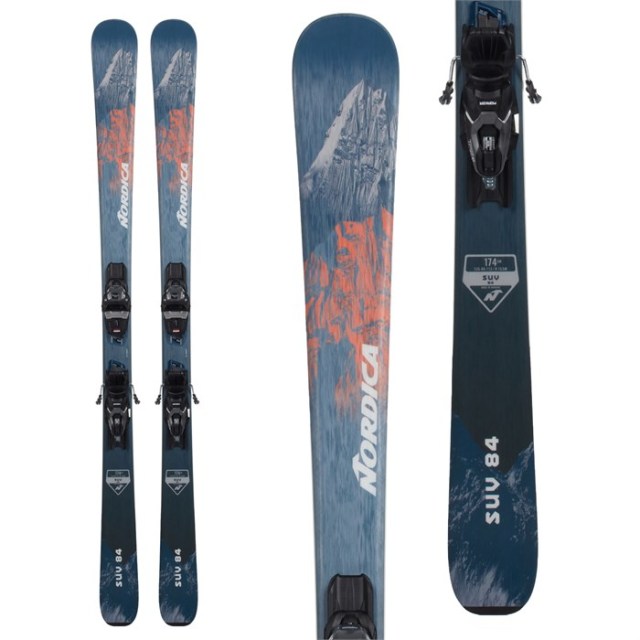
These aren’t the cheapest skis on the market. They also aren’t the softest flexing. But these skis are great go-to skis for beginners for more reasons than just price and performance.
I’ve ridden and seen quite a few Nordica skis (I’ve also used their ski boots). The build quality is excellent. And Nordica gear is available on multiple continents.
So, if you’re looking for a good first pair of skis, chances are you can find these for sale in your area.
Next, these skis come with bindings. For about $500, you get a pair of skis that’s ready to step into.
Lastly, keep in mind that these skis are ideal for skiers who’ve been skiing at least a few times before, and are ready to take the plunge and get their own sticks. They’re a tad stiffer. But that means that they’ll suit you as you advance, and you won’t be outskiing them any time soon.
In short, these skis deliver the most overall value, because you won’t have to drive far to get them. And they’ll last for several seasons before you need to get more capable skis to match your improved skills.
Lastly, for many recreational skiers, these skis will be they only ones you’ll ever need.
Women’s skis (shorter, lighter skiers)
Rossignol Black Ops Smasher

Some of the reasons I recommend the Rossignol Black Ops Smasher skis are the same as the reasons for recommending the Nordica SUV 84 skis.
These are the most value, for the most people. The main difference here is that the Rossignol Black Ops Smasher skis are offered in a broader range of lengths. They’re available in shorter lengths, which is ideal for shorter skiers.
Additionally, these skis are slightly wider than the Nordica SUV 84. It’s nice if you want an all-mountain and all-conditions ski. With good technique, you can get away with riding these skis in a bit of fresh snow.
Honestly, these skis will work for anyone, man or woman. If you’re heavier and/or taller, get the longer length. These skis are available in sizes from 150cm to 180cm. And they’ll work for almost anyone. But the availability of 150cm and 160cm models is great for shorter, lighter skiers.
Something you can take with you as you progress through your skiing career is to remember that it’s wise to consider more than just the performance when buying skis.
To some, sure performance will be king, and that’s cool. But for most, it’s good practice to consider how much work it will be to get those skis, and how long they will work for you as you get better at skiing (and age, or move to a different part of the world).
In any case, once you’ve got your skis, the only way to get any value out of them is to go ski. So get out on the hill!
Then let me know in the comments what your first pair of skis were!
I am not affiliated with Evo.com.
 The Casual Skier


Pingback: New Skier Gear Guide: Boots [2022] – The Casual Skier